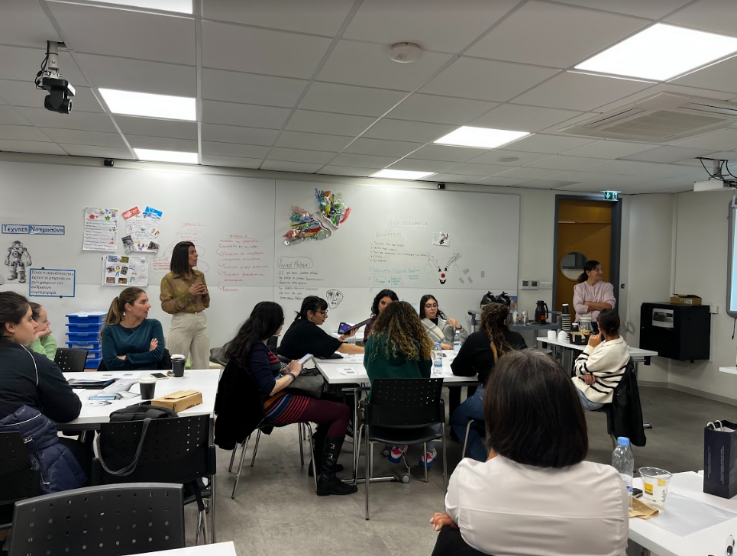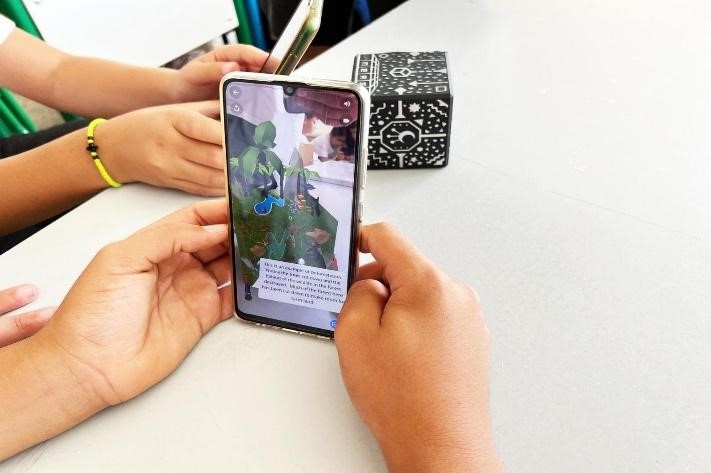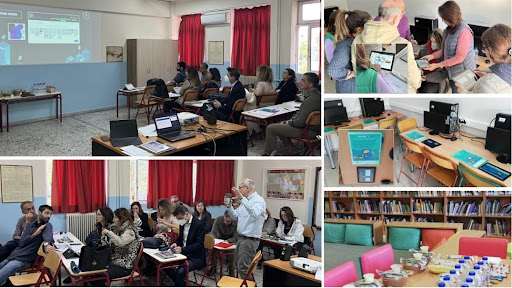
The multiplier event in Cyprus was completed during November and December 2022 as a series of three events with the participation of 21 teachers and students. Specifically, the events were completed on the 30th of November, 2nd of December and 14th of December 2022. During the three events, the GEN-AI project was presented in detail to all participants. Specifically, the aim, objectives, description of the results of each project output, the project website and the eLearning platform were some of the main components of the event programme. The participants were very enthusiastic about the resources developed and their interactiveness and stated that they will definitely integrate the resources in their teaching practices and recommend them to other colleagues. With the finalization of the Multiplier Event, all participants were asked to evaluate both the event and the eLearning Platform on a 5-point Likert scale (where 1 represents «Strongly Disagree» and 5 represents «Strongly Agree»). The majority of the participants rated the items of the evaluation with the highest rates of the scale regarding the ease of use, content and design of the Generation AI e-learning platform, including the Basic & Advanced Lesson Plans and the GEN AI Toolkit (Best Practices, Pedagogical Framework, etc.).


The IO3 pilot implementation phase in Cyprus was completed during May with 28 students and 2 teachers participating. The first lesson plan (basic) was piloted on the 4th of May and the implementation phase was completed on both the 13th and 26th of May 2022. Then, the second lesson plan (advanced) followed, having its pilot phase on the 3rd of May and the implementation phase on both the 27th of May and the 8th of June. Both teachers received training and attended workshops on AI in education in advance. During the implementation phase, both teachers and students were surveyed, having teachers being interviewed upon the completion of the lessons.
From students’ responses it was highlighted that students overall enjoyed the lessons and reported that they have learned how AI can support them in their everyday routine. Additionally, they have found the resources of the lessons very interesting (highest percentage was the games element) and mentioned that they will recommend them to their peers.
Teachers’ overall responses illustrate that the Generation AI Lesson plans are useful and helped them develop their PD by improving their AI – knowledge. They also rated the quality of learning activities, the challenges and games as excellent components of the AI lesson plans. Finally, they would recommend the Generation AI School program to other primary education teachers and would be happy to share the learning material to their network.


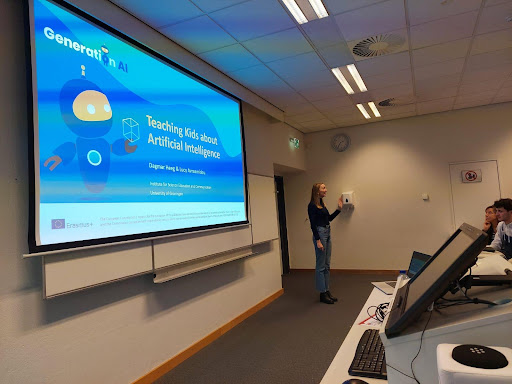
On November 10th, the University of Groningen hosted the final conference of the Generation AI project. The RUG team presented the project results to 49 participants! Both pre-service, and experienced teachers attended the conference.
All participants engaged in interesting discussions on ‘’why should we teach about AI” and they had the change to check out the project website and try out the e-learning platform with the AI lesson plans available.
Andreea Sburlea, from the University of Groningen, gave an interesting talk on AI and education, and Tijmen Ennik, from NTR, shared an interactive AI tool for primary school students they developed.
Overall, the participants gave very positive feedback on the conference and the RUG partners received positive and valuable feedback on the Generation AI project.


The European Erasmus+ project «Generation AI», in addition to the diverse educational material it created, produced and implemented 10 learning and teaching projects for primary school students, which are analysed in the «e-Learning Platform » of the project, and they start with a short video. All videos produced are shared on the project’s YouTube channel. Each such learning and teaching school comprises the following 1+3 sections (e.g. Lesson Plans / Content Creation):
The example below describes a photo recognition activity in 5 distinct steps (see related video).


By discussing which photos, the camera recognizes and which do not, we can draw conclusions with a final reflection and review activity, which can be done with issues such as:

The Rural Hub are happy to publish the Sustainability Plan for the Generation AI project. This Sustainability Plan has been developed in consultation and with support from all partners in the Gen Ai project. The Plan presents the list of actions and strategies that Generation AI Project Partners will employ to ensure the future use and sustainability of all Generation AI project products and outputs once the project has come to an end. This sustainability strategy covers the project period, which began in December 2020, and will run until November 2022; and for many of the plans outlined in this strategy document, you will see that the future use of the Generation AI materials is being planned for years into the future. This plan has been drafted by The Rural Hub with support from all members of the Generation AI project consortium.

The Rural Hub has been responsible for the management of the Quality Assurance processes in the Generation AI project. As part of this process, The Rural Hub has been supported by all partners to complete regular quality checks throughout the lifecycle of the project. In managing the quality of the project, all partners followed a 3Ps approach to quality management. As part of this model, we assessed the quality of the project is terms of the Process and Project management of the project, the Partnership and the quality of the Products developed by the project team. Throughout the evaluations completed by the project partners, all aspects were evaluated as very positive. Some comments from the final evaluation include:
This shows that the consortium has worked very well together over the course of this project.

The Rural Hub has been responsible for managing the impact assessment activities of the Generation AI project partners. This activity has been supported by all partner organisations. The strategy that has been implemented for the Generation AI project follows the structure of the IMPACT+ Framework that was developed by the UK and Slovenian National Agencies, as a means of supporting project consortia to measure and track the impact that their project activities are having on a local, regional, and national levels. In following this structure, Generation AI project partners were asked to develop an indicator set which addressed the intended impact of each Intellectual Output to their national context by estimating expected impacts at each of the following levels: Systemic – This Area of the Impact+ Assessment focussed on the impact of the intellectual output (IO) in relation to the sector, subject area of the project, peer or beneficiary networks, policy, or legislative change, etc. Organisations – This Area of the Impact+ Assessment focussed on the impact of the IO in relation to the operation and service/training offering of project partner organisations. Learners – This Area of the Impact+ Assessment focussed on the impact of the IO in relation to individual learners or staff (tutors or mentors), etc. who will be engaged in the learning, teaching, and training activities foreseen in the project application. Project Staff – This Area of the Impact+ Assessment focussed on the impact of the IO in relation to project staff who are managing and coordinating the project in each partner organisation. Throughout all of these activities, we can positively evaluate the impact that Generation AI has had on introducing AI into the teaching curriculum and strategies of schoolteachers in our regions, which is a fantastic result for our project!

The testing of the Generation-AI Programme for Primary School students took place with 3rd, 4th, 5th, and 6th class students during a Science Day education fair in the Convent of Mercy National School in Belturbet, County Cavan, on Tuesday, 31st May 2022. In total, we reached approximately 35 – 40 students on this day. For these workshops, the teachers and trainers from The Rural Hub specifically tested our module on Communication and Collaboration. As this testing was completed with students in upper primary school classes, we tested Lesson Plan 2 for students aged between 9 and 11 years. As part of this event, The Rural Hub hosted over 80 students in the school hall and presented the Generation-AI project before splitting students into smaller groups where they tested different science and STEAM projects that the Rural Hub is a partner in. At this event, we promoted careers for girls in STEAM, the use of robotics in education and the Generation-AI Programme for students (IO3). Throughout this day of activities, trainers from The Rural Hub, and teachers from the Convent of Mercy National School hosted small workshop sessions with students to test the different lesson plans and activities developed by the Gen-AI project team. The students and teachers from these workshops completed a written evaluation form and provided verbal feedback on the day. Most students on the day reported that they really enjoyed the workshops and feel that it is important to bring these types of ‘modern technologies’ into education because this is how we live our lives, and everyone should be able to learn through new technologies and more engaging methods. The challenge with the pizza toppings received very positive feedback with most students saying how interactive it was and commenting that this was more fun to learn by completing this challenge than reading about it or learning like in a ‘normal classroom’. Students overall responded enthusiastically to the workshop and commented that it would help to have more workshops like this in the school Curriculum, especially for teaching about science and technology. The workshops closed at the end of the school day, with the staff from The Rural Hub thanking all students for their participation and thanking the teachers for hosting them.

The Generation AI e-Learning Platform: https://elearning.generation-ai.eu/ has been piloted in Ireland and promoted at our dissemination event! Teachers, parents, and students who participated in this piloting could not believe that so many rich resources were freely available for them to use so that they can embed the Generation AI tools directly in their teaching and education activities. The value of this platform for primary schools in Ireland is very significant, as no such platform existed to bring AI teaching to primary schools in Ireland before this project. This is truly ground-breaking and innovative, and it will ensure that the Generation AI project will continue to have an impact on primary school education in Ireland long after the project comes to an end!

The Rural Hub developed two lesson plans and sets of learning resources on the topic of Communication, Collaboration and AI; one set of lessons for students aged 6 to 8 years, and a second set for students aged 9 to 11 years. This lesson began with a video which explains to students how AI can help us with ordering a pizza. This video is the first element of the Lesson Plan. The second element of these lesson plans are learning activities with a problem-based task. This task consists of a guided activity that aims to help students come up with a reflection about a question/problem proposed. This question/problem aims to give learners the opportunity to know how AI can affect their daily lives in a simple and ludic way. This last element of the Lesson Plan is an AI-based challenge tutorial game. It aims to be the most ludic part of the lesson plan and pretends to conclude with the knowledge acquired during the lesson plan. The tutorial is related to the Communication and Collaboration and is created to help students develop their own game using Machine-based learning and Scratch 3.0. Through these activities and lessons, our aim is to support students from 6 to 11 years to engage with AI as a concept through teaching activities in their classrooms.